Showing posts with label Animal sentience. Show all posts

Thursday, April 7, 2016


AN OPEN LETTER IN GRATITUDE
TO THE MOST REVEREND MICHAEL CURRY,
PRESIDING BISHOP OF THE EPISCOPAL CHURCH

"I do not want the Church to support animals simply to conform to secular pressure, rather I want the Church to see that its own Gospel requires opposition to cruelty."

                                                  ~Andrew Linzey, Creatures of the Same God 

Dear Bishop Curry:
               I do not mind telling you that as someone who tries to work for justice and compassion within the Christian community in general and the Episcopal Church in particular, I am often discouraged.  But on the eve of Easter this year, I was blessed to be in attendance at the Washington National Cathedral to take part in the Easter Vigil and to hear your wonderful and heartening sermon.  Your words have refreshed me and offered me encouragement, and for that I am grateful.  
               You spoke of us, a followers of Jesus, being Why Not People in a Why Weary World; of Christians – even Episcopalians – needing to press on with new ideas in both the Christian and secular communities to make the world a better place.  In world beaten down and made weary by seemingly intractable injustice, we, as followers of the risen Lord, are to hold on to hope, to continue to ask “why not” for a better world. You asked, and recalled others who asked:
  •        Why not a world where children do not go to bed hungry?
  •        Why not a world where we are all the children of God and we treat each other as God’s human family?
  •        Why not scientific truth and knowledge instead of intractable fundamentalism?
  •         Why not an empire that is better and more noble instead of one trading in human flesh?[1]
  •         Why not a world where women and girls are given equal access to education?

Why Not People dream of new possibilities and know that all things are possible with God, despite all evidence to the contrary in a Why Weary World.  So, refreshed and encouraged, I will ask:

Wednesday, November 25, 2015

REFLECTIONS ON THANKSGIVING, 2015

“Cruelty to animals is as if man did not love God.”

                                                ~ Cardinal John Henry Newman 

                Thanksgiving is a difficult time for vegans.  We love a good feast with family and friends as much as the next person, but the great fuss made over the turkey is hard to take.  We know that more than 46 million birds will die for Thanksgiving.  We know that nearly all of them come from factory farms, where they have been bred to be mere caricatures of the birds God created, with breasts so big they cannot mate naturally and with such a fast growth rate that they often suffer serious leg and joint problems.  They have often had their beaks and toes cut off without anesthesia to keep them from harming other birds due to the overcrowded, stressful, and dirty conditions in which they live.  We know that as birds, under US law, they are not even afforded the minimal protections of the Humane Methods of Slaughter Act in the slaughter process.  And we know that the slaughter process is terrifying and often badly done, resulting in significant suffering.  We know that year after year, investigations of turkey farms have revealed horrific treatment of these gentle birds, even when they are supposed to have been “humanely raised.” 
               We also know that turkeys, when allowed to live in peace, are intelligent, social, affectionate birds, that they are loved by the God who created them, and that their suffering matters.  It is extremely difficult for us to understand, therefore, how participating in cruelty toward them can in any way, shape, or form be related to giving thanks to God for His great mercies toward us.  
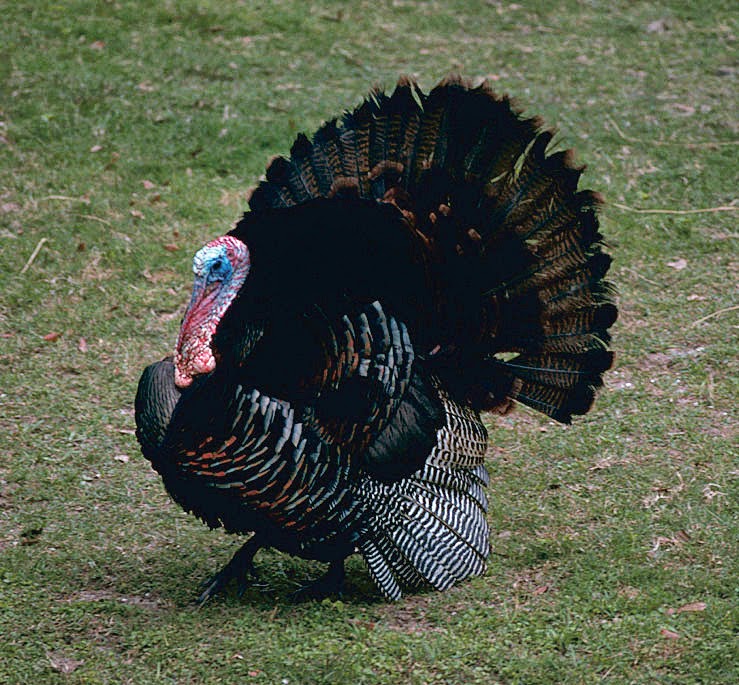
Wild turkey
Butterball turkey, photo by Mercy For Animals


Thursday, September 10, 2015


A NEW CREATION FOR THE ANIMALS, 
OR, DO ALL DOGS GO TO HEAVEN?

The wolf shall live with the lamb, the leopard shall lie down with the kid,
The calf and the lion and the fatling together, and a little child shall lead them. . . .
They will not hurt or destroy in all my holy mountain;
For the earth will be full of the knowledge of the Lord as the waters cover the sea.

                                                                  ~ Isaiah 11:6, 9

            Before my forced blogging hiatus as a result of a broken wrist, I was blogging my way through David Clough’s On Animals, Volume 1: Systematic Theology.  Although it has been some time since my last post on the topic, there is but one chapter left and I think it is time to let the last shoe drop.  As you know if you read those previous posts, I cannot recommend this book highly enough; it provides a very thoughtful and wide-ranging discussion of the place of animals – and humans – in Christian theology, considering our modern understanding of animal nature together with a careful reading of scripture and Christian tradition.  For Clough, taking animal welfare seriously is simply a matter of living in accordance with what Christians have always believed.  I am especially grateful for Clough’s emphasis on animal welfare as “a vital theological task,” which touches on nearly every element of what it means to be a Christian, and for the way he consistently urges us to look at and understand animals in new ways, asking us to appreciate their complexity, their individuality, and their place in the world.  Previous posts in this series are A Vital Theological Task, All Creatures of Our God and King, On Humans and Other Animals, The Heart of the Matter, and Do Animals Sin?  There is also a discussion with the author himself, Q&A With David Clough.  This post will look at Part III of Clough’s book, asking whether animals will be redeemed together with humans.

Thursday, May 14, 2015


AND THE SECOND IS LIKE UNTO IT
Master, which is the great commandment in the law? Jesus said unto him, Thou shalt love the Lord thy God with all thy heart, and with all thy soul, and with all thy mind.  This is the first and great commandment. And the second is like unto it, Thou shalt love thy neighbor as thyself.  On these two commandments hang all the law and the prophets.
                                                                        ~  Matthew 22:36-40 (KJV)

But wishing to justify himself, he said to Jesus, "And who is my neighbor?"
                                                           ~  Luke 10:29 (NAS)

            I don’t think it stirs much controversy to say that we cannot claim to love God if we do not love our neighbor, or to say that loving our neighbor does not mean that we have nice, warm feelings about that neighbor or even that we think highly of him or her; rather it is to say that we are willing to reach out to help when that person is in need or that – at the barest minimum – we refrain from treating him or her with cruelty.  It is to say that we have a responsibility for that person’s well-being. 
            Scripture, both the old and new testaments, makes clear that this is a central tenant of the Judeo-Christian faith.  Christ calls it the second great commandment, likens it to loving God, and says that on it (and on loving God) depend the rest of the scriptures.  Because we can’t really get around this requirement, since ancient times we have instead been trying to ease its burden by limiting the definition of “neighbor.” 
Jesus with the Pharisees - Gustav Dore

Thursday, January 22, 2015


DO ANIMALS SIN?           
“The Lord regretted that he had made human beings on the earth, and his heart was deeply troubled.  So the Lord said, ‘I will wipe from the face of the earth the human race I have created – and with them the animals, the birds and creatures that move along the ground – for I regret that I have made them.
                                                                          ~  Genesis 6:6-7

            Throughout his book, On Animals, David Clough consistently challenges our common human understanding of “animals” as simple creatures, wholly separate from humans.  Instead, he develops a complex image of our fellow creatures, urging us to appreciate the wide range of creatures with whom we share this planet, the richness and complexity of their lives, and many ways humans and other animals are alike.  In addressing the doctrine of atonement, he continues to invite us to broaden our understanding of other animals’ places before God, asking, among other things, whether animals sin and whether they are in need of reconciliation with God.     

Saturday, December 20, 2014


POPE FRANCIS AND THE ANIMALS
“And the Word became flesh and lived among us . . .”
                     ~ John 1:14
“Man and beast thou savest, O Lord.”
                        ~ Psalm 36:6b

            There has been a great deal of press coverage about Pope Francis and a statement he was reported to have made to console a young boy who had lost a pet.  “Paradise is open to all God’s creatures.”  The statement immediately filled the internet with all manner of people weighing in on what this might mean for Christians.  I posted a link to this story about the statement on the Dominion In The Image Of God Facebook page.  It got quite a number of views.  Then it turned out he didn’t say that after all (although Pope Paul VI apparently did).[1]  According to the Regions News Service, what he really said, citing the Apostle Paul in a discussion of the End Times, was that the new creation was not the annihilation of all that is, “but the bringing of all things into the fullness of being.”  The New York Times’ corrected story quotes him as saying, “Holy Scripture teaches us that the fulfillment of this wonderful design also affects everything around us.”  The Religion News Service has a very helpful story about how the Pope’s statement became transformed through interpretation and errors in reporting. 
            Whatever the Pope’s actual words, the story got a lot of people talking about whether we will, indeed, see our pets and other animals in heaven.  
St. Blaise with animals


Saturday, October 18, 2014

TALKING TURKEY

Think occasionally of the suffering of which you spare yourself the sight.”   
                                                                                                         Rev. Dr. Albert Schweitzer  

      As the holiday season approaches, and we all start planning our feasts, especially our Thanksgiving feasts, I wanted to share this short article from Farm Sanctuary's Sanctuary magazine, from the Fall/Winter 2014 issue.  This is by Susie Coston, Farm Sanctuary's National Shelter Director (I think she must have the best job in the history of jobs.)  If you are not familiar with Farm Sanctuary, please check out their web site.  It is an excellent resource to learn about issues affecting farm animals and to learn the wonderful and heartwarming stories of the animals Farm Sanctuary has rescued and cares for at its three sanctuaries.  

Here is the article:

Thanksgiving is a bitter season for turkeys, with more than 46 million slaughtered for the holiday every year.  During their foreshortened lives, most of these bird suffer intense crowding, and their sensitive beak-tips are amputated to discourage fighting in these stressful conditions.  Selective breeding has designed them to grow so rapidly and so large that it strains their bodies and prevents adult birds from flying or perching.  Knowing this, you might think it would be depressing to hang out with rescued turkeys.  But it's not.  It's a joy.

The industry has taken so much from these animals, but it has done nothing to dull the keenness of their perceptions or the liveliness of their curiosity; it has not dimmed their vivid awareness of (or strong opinions on) their surroundings; it has not diminished the depth of their feelings or the vitality of their friendships.  Every turkey is different -- this one mellow and affectionate, that one daring that one shy -- but all of them are so alive.
 This Thanksgiving and Christmas, consider adding to your list of things to be thankful for your ability to be compassionate.  Give thanks to God for the wonder of these marvelous birds and celebrate God's mercy by showing mercy.  Adopt a turkey at Farm Sanctuary instead of eating one.  There are so many wonderful meat-free alternatives, you will never miss it.  Here, selected somewhat at random, is a link to plant-based Thanksgiving recipies from Forks Over Knives.  There are LOTS more available with a quick google search.   As Farm Sanctuary says, "A compassionate world begins with you."  I'm sure the Good Shepherd would agree.
Eastern Wild Turkey, G. Stoltz, US FWS

Friday, March 21, 2014


ARE CHURCH LEADERS SENTIENT?[1]
The question is not, Can they reason? nor, Can they talk? but, Can they suffer?
                                                                 ~  Jeremy Bentham, 1748-1832
                    An Introduction To The Principles Of Morals And Legislation

            I apologize that this week I have not had time to write a reflection on scripture and animals.  I did, however attend a two-day conference this week entitled The Science of Animal Thinking and Emotion: Sentience as a Factor in Policy and Practice, and I’d like to offer just a few thoughts on why I attended this conference, what I learned, and why the church should care. 
            The conference was sponsored by the Humane Society Institute for Science & Policy and featured scientists and policy makers from a wide range of disciplines and from around the world.  We learned about studies being done regarding the emotional and intellectual lives of dogs, chimps, bonobos, fish, farm animals, prairie dogs, and crocodilians.  We heard about the impacts the advances in our understanding of animal sentience has had in the European Union, strides being made in China, and the role of media in shaping public understanding and opinion of proper treatment of animals.  It was a very full two days. 

Thursday, March 13, 2014


Psalm Of A Downed Dairy Cow

“A cow’s a piece of machinery.  If it’s broke, we try to fix it, and if we can’t, it’s replaced.”
                                                 ~ quoted in Dominion, The Power of Man, The Suffering of Animals, and The Call to Mercy by Matthew Scully

            Following up last week’s post on animals and Sabbath, and in keeping with a Lenten theme of penitence, I offer this “psalm.”  It is written from the perspective of a downed dairy cow (that is, a cow so exhausted from over-breeding and over-milking that she cannot stand or walk) in a factory farm, where animals are given no rest, but are manipulated solely for profit, without regard to their most basic needs. This is a system that disregards the rhythm of work, play, and rest, that, as Ex. 20:8-11 tells us, are woven into creation and into the Sabbath commandment, as discussed in last week’s post.
            We know that farm animals have a great deal more intelligence, self-awareness, and emotional depth than previously believed.  They know pain, fear, and loneliness. Those on factory farms know these emotions intensely.  Farm animals do cry out - with bellows and squeals and squawks - and just as the God of the Exodus heard the cries of the slaves in Egypt which were not intentionally cries or prayers to God, so I believe he hears the cries of the animals on factory farms and in slaughterhouses.  This psalm is my effort to render those cries and my understanding of the divine response into a theological representation. 

Friday, February 21, 2014


COMMON CREATURELINESS:
CREATION CARE AND ANIMALS, PART FOUR

“For the fate of humans and the fate of animals is the same; as one dies, so dies the other.  They all have the same breath and humans have no advantage over the animals; for all is vanity.  All go to one place; all are from the dust, and all turn to dust again.”

                                                                  ~ Ecclesiastes 3:19-20.

            In my last three posts, I have looked at the work of various creation care authors who, while making many excellent points regarding our right relationship with the earth, have failed to address our right relationship with animals.  At least one author, however, shows us how a “green theology” perspective can specifically address our obligations to animals.  
          In his book, Living With Other Creatures: Green Exegesis And Theology[1], Richard Bauckham considers how the church has traditionally understood its relationship with animals and reconsiders that relationship, analyzing several scriptural passages that deal directly and indirectly with animals.  He considers two issues in particular, the ecological setting of first century Palestine and Jesus’ role in ushering in the kingdom of God, “in order to show that the kingdom includes the whole of creation and that some of the acts in which Jesus anticipated the coming kingdom point to the redemption of the human relationship with the rest of creation.”[2]  He does this, however, without conflating animals with non-sentient creation. 
           

Friday, February 14, 2014


IS VEGETARIANISM CONTRARY TO GOD’S INTENTIONS?
CREATION CARE AND ANIMALS, PART THREE

In my last two posts, here and here, I have considered the ways in which creation care has made great strides in moving us away from thinking of humans as entitled to exploit the earth, but has failed to bring us to accountability for our treatment of animals.   Too often, creation care authors consider animals as part of “nature,” to be grouped together with plants and waterways, rather than as individual sentient beings, more similar to humans than trees.  Norman Wirzba is a well-known agrarian theologian whose book, Food & Faith: A Theology of Eating[1], illustrates how failing to make this distinction can lead to conclusions that I believe are seriously flawed theologically, ethically, and practically.   
Wirzba proposes that choosing not to eat meat may be thwarting God’s intentions. Wirzba’s reasoning is complex, beginning with the inevitability of death and the Christian belief in death as a means to greater life.  He considers the ancient sacrificial system, which called upon its practitioners to give up something of value, and portrays all of creation as God’s eternal self-giving wherein all creatures feed on one another.  In this context, he theorizes, refusing to eat of God’s bounty, including the animals, is a refusal of God.

Friday, February 7, 2014


PIGS ARE NOT "THE LAND"
CREATION CARE AND ANIMALS, PART TWO

“Speak up for those who cannot speak for themselves; ensure justice for those being crushed.”
                                                                              Prov.31:8, New Living Translation

Last week, I began a look at a theological perspective variously known as “creation care,” “green theology,” “ecotheology,” and similar terms.  I noted that while this perspective has done excellent work in helping us to understand that Scripture places on humans obligations toward the rest of creation, rather than simply conferring rights, it falls short in addressing our obligations toward animals.  The problem lies in the fact that these authors most often fail to distinguish between sentient and non-sentient elements of the non-human creation.  They tend to consider animals as part of “nature.”  This allows them – and us - (intentionally or otherwise) to disregard the fact that animals are individuals and have value apart from their environment.  It also makes it easy to think of animals as “out there” – in the wild somewhere, and lets us avoid turning our gaze on the animals we impact most directly – the ones in places like factory farms and puppy mills and laboratories.[1] 
Ellen F. Davis, in her book, Scripture, Culture, and Agriculture, does turn her eyes directly on farm animals, ever so briefly, and in so doing helps to illustrate the disconnect between concern for animals and concern for the environment even when food is the topic. [2]  Davis has provided what she subtitles “An Agrarian Reading of the Bible.”  She describes agrarianism as “a way of thinking and ordering life in community that is based on the health of the land and of living creatures.”  
            Davis offers in this work a thorough-going indictment of our modern food delivery system.  “In this half-century,” she says, “it has given North Americans probably the cheapest food in human history, but at what cost?”[3]  She addresses at some length the destruction industrial agriculture wreaks on the land, on the farming families who cannot compete with this industrial model, and on “the natural machinery that supports life on Earth,” and puts it all in the context of the biblical covenant and the tie of the ancient Israelites to the land.[4]  She also addresses a host of other natural, economic, and social impacts of industrial agriculture.  One looks in vain, however, for any sustained discussion of the catastrophic suffering industrial agriculture imposes on animals or its theological implications.

Thursday, January 30, 2014


WHALES ARE NOT TREES:
CREATION CARE AND ANIMALS, PART ONE

God intends our care of the creation to reflect our love for the Creator.
                                                      
~   Dr. John R. W. Stott  

In the last several decades a theological movement variously known as “creation care,” “green theology,” “ecotheology,” or similar terms has taken hold in the church.  Theologians writing from this perspective have done yeoman’s work, arguing for a re-imagining of our understanding of “dominion,” away from an idea of unfettered power and toward and idea of “stewardship,” that is, responsible care and management, of the earth and its resources.[1]  Several recent authors addressing this theme have argued that we are to look to Christ as the perfect image of God, which tells us beyond any dispute that “dominion” cannot be understood as power without responsibility.   This last argument may sound familiar to readers of this blog, as I have argued from this same perspective in developing my own arguments about our relationships with animals. 
The main focus of creation care, however, is environmental stewardship, and its proponents often fail to understand or address the distinction between animals as sentient individuals, and the earth, water, and sky, to which we also owe important and related, but differing, responsibilities.  
Photo credit: David Wye
 Creation care, then, is a helpful step away from the traditional understanding of humans as entitled to exploit creation for solely human benefit, but it is insufficient, as currently articulated, to bring us to terms with the cruelty inherent in our current societal relationship with animals and the ways we, as members of faith communities, support that cruelty.  To the good work of these creation care authors we must add an awareness of the theological significance of the suffering of other creatures and recognize our obligations to address that suffering as distinct from, but in concert with, obligations to preserve the non-sentient earth.[2] 

Friday, January 17, 2014


HELLO? CHURCH? ARE YOU THERE?
“When we reflect upon the most shocking barbarities, and see the brutal rage exercised [against animals] by the most worthless of men, without controul of Law, and without reproof from the Pulpit, we are almost tempted to draw this inference, that Cruelty cannot be a sin.”
                                                                  ~ Humphrey Primatt
            Once again I have put my planned post into cold storage so that I can write about something in the news that I think requires people of faith to sit up and take notice.  It is a column by Frank Bruni that appeared in the New York Times on January 13 entitled According Animals Dignity.  It is a very encouraging piece discussing the ways we are slowly beginning to re-conceive our relationships with animals as we come to have a fuller understanding of how they interact with the world and how miserably some of them are treated.  As a culture, of course, we have a very long way to go, but as Bruni points out, there are encouraging signs of change.  As we come to this awakening, however, and as I read Bruni’s discussion of the signs and sources of change, I cannot help but wonder, again, where is the voice of the church?
            Bruni’s article begins by observing that the most e-mailed recent New York Times story was a story entitled “What Your Cat Is Thinking,” reviewing a book on the subject called Cat Sense (by the same author who recently wrote Dog Sense).  He goes on to discuss other articles and books regarding how animals think (including one called Dogs Are People, Too, which, of course, caught my eye because of this recent post) and the growing popular interest in the topic.
           

Friday, January 3, 2014


ASK THE ANIMALS AND THE WILL TELL YOU:
A LOOK AT ANIMAL SENTIENCE
PART THREE:  ANIMAL INTELLIGENCE

“Crows hold a grudge, and they are big gossips.”   ~ Prof. David Craig
“Mice value self-actualizaton.”  ~ Dr. Jonathan Balcombe

In Part One of this series on animal sentience we looked at animals and physical pain.  In PartTwo, we looked at animals and emotions.  In this Part Three, we’ll take a look at animal intelligence.  Humans have consistently underestimated animal intelligence and awareness of the world around them.  We tend to believe that animals go through life with very little understanding of what is happening around them, responding to their environment instinctively.  It turns out, however, that animals are much more intelligent than we have previously believed.  They make choices, they have preferences, they plan for the future and remember the past, and, just like humans, they suffer from boredom if they do not have enough to occupy them.  These realities have an impact on what it means to treat animals humanely and what our obligations of right dominion include.

Friday, December 27, 2013


ANIMALS ARE PEOPLE, TOO
“Then the Lord opened the mouth of the donkey, and it said to Balaam, ‘What have I done to you, that you have struck me these three times?’ . . . The angel of the Lord said to [Balaam], “Why have you struck your donkey these three times?”
                                                        ~ Numbers 22:28, 32

“Animals are people, too.”  I used to say this with some regularly years ago – before I ever dreamed of becoming an animal advocate and when I was blissfully unaware of philosophical controversies over what makes a “person” – because it seemed self-evident to me that animals were unique individuals with their own viewpoints on the world and were therefore “people.”  Fast forward several years to when I was writing my proposal for my master’s thesis at Wesley Seminary. I included some language (I don’t remember what it was) potentially attributing “personhood” to animals.  My advisor warned, “Don’t go there.  You don’t need to, and you’ll only get yourself into trouble.”   
It was good advice, but I am going to “go there” today because I want to talk about justice. 

Friday, December 20, 2013


ASK THE ANIMALS AND THEY WILL TELL YOU:
A LOOK AT ANIMAL SENTIENCE, PART TWO
ANIMALS, EMOTIONS, AND AWARENESS

After a year Louis Leakey arranged for me to go to Cambridge University to work toward a PhD in ethology.  There I was criticized for my lack of scientific method, for naming the chimpanzees rather than assigning each a number, for ‘giving’ them personalities, and for maintaining they had emotions.  For these, I was told sternly, were attributes reserved for the human animal.  I was even reprimanded for referring to a male chimpanzee as ‘he’ and a female as ‘she’:  Didn’t I know that ‘it’ was the correct way to refer to an animal?

                                   ~ Jane Goodall[1]

            In Part One of this series on animal sentience, we saw what most of us already know, but what science has been slow to acknowledge: that animals – including even fish, crabs, and insects -- feel and are aware of physical pain.  We also saw that some of the things humans do to animals, like branding and tail docking, are known to cause real and lasting pain, but continue unabated.  In this Part Two, we will look at animal emotions.
            Animal ethologist Marc Bekoff writes, “Humans and animals share neural pathways when it comes to suffering,” and that includes the emotional element of suffering.[2]  The case against animal emotions is “bad biology,” Bekoff continues, “Scientific research in evolutionary biology, cognitive ethology, and social neuroscience supports the view that numerous and diverse animals have rich and deep emotional lives. . . . Emotions, empathy, and knowing right from wrong are keys to survival, without which animals – both human and nonhuman – would perish.  That’s how important they are.”[3] 
Happy, tail-wagging black lab
“Recognizing that animals have emotions is important,” he says, “because animal feelings matter. 

Friday, December 13, 2013


ASK THE ANINMALS AND THEY WILL TELL YOU:
A LOOK AT ANIMAL SENTIENCE, PART ONE
ANIMALS AND PHYSICAL PAIN

“But ask the animals and they will teach you; the birds of the air, and they will tell you; ask the plants of the earth, and they will teach you; and fish of the sea will declare to you.  Who among all these does not know that hand of the Lord has done this? In His hand is the life of every living thing and the breath of every human being.

                                                                                              ~ Job 12: 7-10

            In this blog, I have argued that our creation in the image of God is inextricably intertwined withour relationships with animals and that we are tasked at the creation with the job of reflecting God’s character to the animals.   I have also argued that how well we carry this out is fundamental to our very character as human beings, that Scripture’s teachings on the use of power are just as applicable to our use of power over animals as they are to our use of power over vulnerable human beings, and that our value as humans comes not from our creation in God’s image but from the fact that we are loved by God, which has implications for the value of other creatures, as well.  In later posts, I will address specific passages of Scripture to see what they may have to say about how we treat animals and look at more recent theological thinking about our relationships with animals and the creation care movement in general.  But first, I want to pause to take a brief look at some of the things science is learning now about animal sentience.  Understanding how animals understand and relate to the world is key to understanding our obligations toward them. 
"Knockout mice" at NIH