Showing posts with label The Good Shepherd. Show all posts

Tuesday, August 4, 2015


I AM CECIL

“If you have men who will exclude any of God's creatures from the shelter of compassion and pity, you will have men who deal likewise with their fellow men.”

                                                               ~    St. Francis of Assisi


We have all heard a great deal about Cecil, the lion in Zimbabwe who was killed by an American dentist on safari.  Cecil was not just any lion; he was a lion being tracked by researchers inside a national park.  He was well known for his magnificent black mane and he was a favorite with locals and tourists.  Nor was this just any hunting expedition.  This was a guaranteed kill outing and it is reported that Cecil, who, popular as he was, had become accustomed to humans, was intentionally lured outside the protections of the park with an animal carcass so that he could be “legally” killed.  And it was not just any kill.  Cecil was shot with an arrow, which failed to kill him, and he suffered for upwards of 40 hours – nearly two days - before he was finally found and killed with a shotgun.  He was then skinned and decapitated so the American, who had paid more than $50,000 for the privilege, could have his trophy.
            There is so much about this to be outraged over – and many people and nations have been outraged.  There is now a proposal in the senate to ban the import of animal trophies not just to animals on the endangered species list, but to those proposed for listing as well.  Botswana has banned sport hunting and exporting of wild animals, including lions, from the country.  Several airlines are now refusing to carry trophy animals. This tragedy has, at least, put a spotlight on this terrible “sport” and some good will result.   
            But is this a Christian concern?  The secular world is moving on this.  Does the church need to do anything?  Absolutely.

Monday, April 20, 2015


WE ARE PHARAOH AND PHARISEE

Almighty and everlasting God, who in the Paschal mystery has established the new covenant of reconciliation: Grant that all who have been reborn into the fellowship of Christ’s body may show forth in their lives what they profess by their faith; through the same Jesus Christ our Lord, who lives and reigns with you and the Holy Spirit, one God, for ever and ever.

                                                 ~ Collect of the Day, Second Sunday of Easter,
                                        Book of Common Prayer, p. 172-73

            As Christians observe the Great Fifty Days of Easter, it is time to reflect on the work that Christ has done for us on the Cross, giving us new life, reconciling us with God, and showing us what it means to be created in the image of God and how power and status are rightly used.  It is an opportunity, too, to consider where we fit into Easter story and its antecedent, the Exodus story.  In both of these stories, God breaks into the history of the world to free those who are prisoners and to help those who are unable to help themselves. 
            I think most of us, if we imagine ourselves in the Exodus story, imagine we are among the Israelites, laboring and yearning for freedom.  When we hear the Easter story, and the gospel stories generally, we like to think of ourselves as among the disciples.  In both cases, we are among the chosen.  To be sure, both the Israelites and the disciples are flawed in their ability to hear what God is telling them and to do His will, and we identify with those shortcomings and struggles, but they are, nevertheless, the ones in relationship with God. 
But in many ways Christians today are more closely aligned with Pharaoh and the Pharisees.  We do not hear the cries of those we oppress; we believe we are entitled to oppress certain others because of our God-like status as bearers of God’s image; and we believe that our particular status before God means we do not need to be concerned with those not in our favored group.  Like Pharaoh and Pharisee, if we do not open our eyes, our ears, and our hearts, we will pay a price.
In the Exodus story, Moses seeks freedom for his people, but Pharaoh refuses.  Moses returns time and again, each time warning of a new plague if Pharaoh will not free the Hebrews. Pharaoh, however, hardens his heart and the plagues come, each one worse than the last. Pharaoh would not hear the cries of the Israelites, and he would not let them go, both because he benefitted from their misery and because he did not believe their misery mattered. He let greed, vanity, and pride rule his heart.  In the end, the entire nation of Egypt and Pharaoh himself suffered great devastation because of that greed, vanity, and pride, and Pharaoh learned he was not so powerful after all.
Tissot, Moses Speaks to Pharaoh

Thursday, February 5, 2015


THE WHOLE LOGIC OF BEING CHRISTIAN
"Cruelty is the worst of heresies."
                                               Humphrey Primatt 

     I have tried to argue in several of my posts that the theology of animal welfare is not just something for animal lovers to be concerned about.  It is fundamental to our very creation in God's image, something Bruce Waltke has called "fundamental to . . . the entirety of scripture."[1]  Moreover, our relationships with animals are grounded in our understanding of the right use of power, a theme that runs throughout the Bible.  David Clough has called understanding these relationships "a vital theological task," and Matthew Scully has explained that these relationships have to do with "the whole logic of being Christian."  We cannot understand who we are as human beings in relationship to God if we do not understand who we are as human beings in relationship to the animals.  Whether we consider ourselves "animal people" or not, we cannot disregard our fellow creatures if we want to follow Christ

     With that in mind, I wanted to repost this essay from September 27, 2013, an early post in which I tackled one aspect of this theme. 


DOMINION AND POWER

He has shown you, O mortal, what is good. And what does the LORD require of you? To act justly and to love mercy and to walk humbly with your God.

~ Micah 6:8

The second half of Genesis 1:26 tells us that, coupled with creation in His image, God gave us dominion over the animals.  Bruce Birch explains, “God’s resolve to create in the divine image is coupled with a commissioning to have dominion. . . . It is as representative (image) of God that we are given capacity for power in the world.”[2]  Birch adds, “We are not absolute monarchs in the world but trustees or stewards acting in behalf of God’s sovereignty as Creator.”[3]  Moreover, because our authority over animals is a delegated power, it is not absolute; it is answerable to God, who ultimately rules over all.  This delegation of power over creation comes with an “implied moral norm [that measures] human actions by reference to their faithfulness in reflecting God’s will and ultimate rule.”[4]  Likewise, Christopher Wright explains, that exercise of power over creation “must reflect the character and values of God’s own kingship” and requires careful reflection on the character of God.[5]

Friday, December 5, 2014


IN CONVERSATION: 
Q&A With David Clough

"When Christians get the chance to think about these issues, they recognize that treating other animals better is an obvious step to take in putting into practice a faith-based view of the world."

                                          -  David Clough
   
         Not long ago, I reached out to David Clough, whose book On Animals Volume I: Systematic Theology, I've been discussing in my last few posts (here, here, and here).  We corresponded about his book and his thoughts about animal advocacy within the Christian community, where it stands now, where it may be going, and what we can do.  Here are some of his thoughts on these topics and others.

Q:      How did you first become interested in animals as a matter of theological concern?

A: Questions of origin are always interesting! I remember a classmate at school giving a presentation against laboratory research on animals when I was 14 that impressed me. I also remember sitting alone on a Scottish hill in the Cairngorms during a hiking trip, and witnessing a reindeer walk past only a short distance away, look at me in the eye for what seemed a long time, and then amble slowly off. I became vegetarian when I was 18. I’m convinced that my Christian faith was a key influence on this choice: a simple belief that that if it’s possible to live without depending on the suffering and killing of others of God’s animal creatures, that is obviously preferable for Christians. Since then I’ve been surprised at how few fellow Christians make a similar connection, and I think it was that puzzlement, a sense of wanting to explore the issue in depth, and a sense of the scandal in the way we treat other animals, especially in intensive farming, that motivated me to focus my academic work on the topic. I’d like to persuade fellow Christians that they have faith-based reasons for respecting the lives of their fellow animal creatures before God. 


Saturday, October 18, 2014

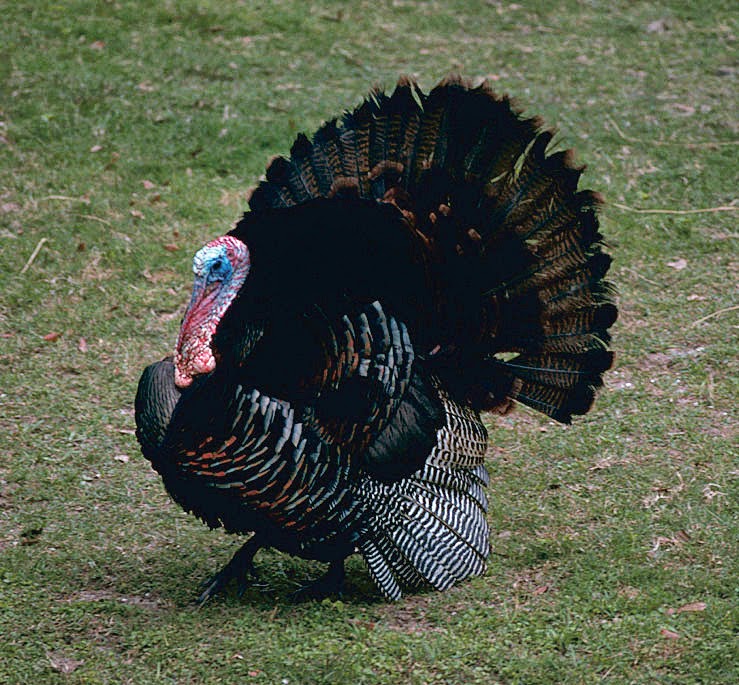
TALKING TURKEY

Think occasionally of the suffering of which you spare yourself the sight.”   
                                                                                                         Rev. Dr. Albert Schweitzer  

      As the holiday season approaches, and we all start planning our feasts, especially our Thanksgiving feasts, I wanted to share this short article from Farm Sanctuary's Sanctuary magazine, from the Fall/Winter 2014 issue.  This is by Susie Coston, Farm Sanctuary's National Shelter Director (I think she must have the best job in the history of jobs.)  If you are not familiar with Farm Sanctuary, please check out their web site.  It is an excellent resource to learn about issues affecting farm animals and to learn the wonderful and heartwarming stories of the animals Farm Sanctuary has rescued and cares for at its three sanctuaries.  

Here is the article:

Thanksgiving is a bitter season for turkeys, with more than 46 million slaughtered for the holiday every year.  During their foreshortened lives, most of these bird suffer intense crowding, and their sensitive beak-tips are amputated to discourage fighting in these stressful conditions.  Selective breeding has designed them to grow so rapidly and so large that it strains their bodies and prevents adult birds from flying or perching.  Knowing this, you might think it would be depressing to hang out with rescued turkeys.  But it's not.  It's a joy.

The industry has taken so much from these animals, but it has done nothing to dull the keenness of their perceptions or the liveliness of their curiosity; it has not dimmed their vivid awareness of (or strong opinions on) their surroundings; it has not diminished the depth of their feelings or the vitality of their friendships.  Every turkey is different -- this one mellow and affectionate, that one daring that one shy -- but all of them are so alive.
 This Thanksgiving and Christmas, consider adding to your list of things to be thankful for your ability to be compassionate.  Give thanks to God for the wonder of these marvelous birds and celebrate God's mercy by showing mercy.  Adopt a turkey at Farm Sanctuary instead of eating one.  There are so many wonderful meat-free alternatives, you will never miss it.  Here, selected somewhat at random, is a link to plant-based Thanksgiving recipies from Forks Over Knives.  There are LOTS more available with a quick google search.   As Farm Sanctuary says, "A compassionate world begins with you."  I'm sure the Good Shepherd would agree.
Eastern Wild Turkey, G. Stoltz, US FWS

Thursday, March 13, 2014


Psalm Of A Downed Dairy Cow

“A cow’s a piece of machinery.  If it’s broke, we try to fix it, and if we can’t, it’s replaced.”
                                                 ~ quoted in Dominion, The Power of Man, The Suffering of Animals, and The Call to Mercy by Matthew Scully

            Following up last week’s post on animals and Sabbath, and in keeping with a Lenten theme of penitence, I offer this “psalm.”  It is written from the perspective of a downed dairy cow (that is, a cow so exhausted from over-breeding and over-milking that she cannot stand or walk) in a factory farm, where animals are given no rest, but are manipulated solely for profit, without regard to their most basic needs. This is a system that disregards the rhythm of work, play, and rest, that, as Ex. 20:8-11 tells us, are woven into creation and into the Sabbath commandment, as discussed in last week’s post.
            We know that farm animals have a great deal more intelligence, self-awareness, and emotional depth than previously believed.  They know pain, fear, and loneliness. Those on factory farms know these emotions intensely.  Farm animals do cry out - with bellows and squeals and squawks - and just as the God of the Exodus heard the cries of the slaves in Egypt which were not intentionally cries or prayers to God, so I believe he hears the cries of the animals on factory farms and in slaughterhouses.  This psalm is my effort to render those cries and my understanding of the divine response into a theological representation. 

Friday, November 29, 2013


ON IMAGE AND VALUE
“God saw everything that he had made, and indeed, it was very good.”
                                                                     ~  Genesis 1:31

            It is something of a theological commonplace that human beings have a unique inherent value because we are created in the image of God.  So imbedded is this idea, in fact, that it is even right there in Wikipedia:
The Image of God (Hebrew: צֶלֶם אֱלֹהִים; tzelem elohim, lit. "image of God", "image of the Holy Spirit", often appearing in Latin as Imago Dei) is a real image, concept and theological doctrine in Christianity, Judaism and Sufi Islam which asserts that human beings are created in God's image and therefore have inherent value independent of their utility or function.[1]

By way of just a few recent examples of this idea in current theological writing: Dr. Denis Alexander of the Faraday Institute for Science and Religion has explained:
Theologians have spent many centuries mining the rich vein of the 'image of God' metaphor. Central to the idea is humanity with spiritual capabilities and responsibilities, equipped for moral decision-making and a relationally rich life in community. Historically, the idea has contributed to the conviction that each human individual has an absolute value, independent of their ethnicity, educational level, health status or income.

Dr. Art Lindsey of the Institute for Faith, Work, and Economics has likewise stated
Note that mankind is made in the image and likeness of God, meaning that human worth is connected to the Creator. If God is of great and inestimable worth, then human beings made in his image must be of great value. Note also that man and woman have equal dignity before God as his image-bearers.

And Dr. Ellen Davis has written:
Before anything else, creation in the image of God indicates that human life has both value and form: inestimable value and a form that is uniquely and richly expressive of divine intentions.[2]

I beg to differ.
           

Friday, September 27, 2013


DOMINION AND POWER

He has shown you, O mortal, what is good. And what does the LORD require of you? To act justly and to love mercy and to walk humbly with your God.

~ Micah 6:8

The second half of Genesis 1:26 tells us that, coupled with creation in His image, God gave us dominion over the animals.  Bruce Birch explains, “God’s resolve to create in the divine image is coupled with a commissioning to have dominion. . . . It is as representative (image) of God that we are given capacity for power in the world.”[1]  Birch adds, “We are not absolute monarchs in the world but trustees or stewards acting in behalf of God’s sovereignty as Creator.”[2]  Moreover, because our authority over animals is a delegated power, it is not absolute; it is answerable to God, who ultimately rules over all.  This delegation of power over creation comes with an “implied moral norm [that measures] human actions by reference to their faithfulness in reflecting God’s will and ultimate rule.”[3]  Likewise, Christopher Wright explains, that exercise of power over creation “must reflect the character and values of God’s own kingship” and requires careful reflection on the character of God.[4]
  The Ruler we are to represent, as Walter Brueggemann explains, is “one who governs by gracious self-giving.”[5] Citing 2 Cor. 4:4 and Col. 1:15, Brueggemann argues that Christians are to view their dominion through the lens of Jesus Christ, whose “identity as God’s image on earth is evident in his readiness to turn from himself toward creation . . .”[6]  Jesus shows us that it is the nature of God to look after the interests of others, even those of “lesser value.” 

Moreover, as Terrence Fretheim explains, this duty of nurturing care “centers on the animals.”[7]  It is the animals to whom we owe this precious duty.  The animals are intended to know the character God through interactions with humans.  The entire structure of creation as God intended it, Fretheim contends, is intended to bring “the world along to its fullest possible creational potential.”[8]  Dominion is, Fretheim says, “a power-sharing relationship” with God, connoting “care-giving, even nurturing, not exploitation,” and imposes on humans the responsibility to “relate to the nonhuman as God relates to them.” [9]
If we are sharing power over creation – and in particular over the animals – with God, that should lead us to ask: what is the right exercise of power? 

Wednesday, September 18, 2013


WHAT DO ANIMALS HAVE TO DO WITH CHARACTER?

“If you have men who will exclude any of God's creatures from the shelter of compassion and pity, you will have men who deal likewise with their fellow men.”

                                                       ~   St. Francis of Assisi
     
      If it is true that our exercise of dominion over animals is intertwined with our creation in God’s image, then it is also true that how we relate to animals is reflective of who we are.  God tasked humans with, indeed in the NIV translation of Genesis 1:26, God created humans for the express purpose of, reflecting God’s character to the rest of the creatures through the exercise of dominion.  How we exercise that dominion, then, is reflective of what we were created to be and to do – and thus, of who we are. 
            This connection has been recognized in Scripture, in theology, in philosophy, and even in modern law enforcement.  How then is it that faith communities continue to ignore the impact of large-scale institutionalized animal cruelty on who we are and how we relate to God?
The connection between how we relate to animals and our central character is a theme that runs quietly through much of Scripture.  In Proverbs, for example, we learn that caring for one’s animals is a sign of righteousness (Prov. 12:10).   Moses found his bride and his father-in-law Jethro after helping Jethro’s daughters to water their sheep (Ex. 2:15-22).  He also discovered the burning bush while tending his father-in-law’s sheep (Ex. 3: 1-2).  The Midrash[1] explains “how Moses discovered the burning bush while he was carrying a stray sheep back to the flock.  It was not great strength that qualified him as a leader, nor a sharp mind, good looks or personal wealth. It was his great compassion for the smallest and weakest among his charges that made Moses fit to lead the nation.”[2] 


Thursday, September 12, 2013

WHAT IS THIS BLOG ALL ABOUT?

He expected justice, but saw bloodshed; righteousness, but heard a cry.
                               Isaiah 5:7

Welcome to Dominion In The Image Of God!  I hope you will visit the About This Blog and About Me pages to learn more about what has motivated me to launch this project and why I believe this topic is so important.  It starts with Genesis 1:26, which tells us that our relationships with animals are inextricably linked with our creation in God’s image.  I believe that, just as our creation in God’s image has been called foundational to what it means to be human[1], so our relationships with animals are foundational to who we are and how we relate to God.  It is my hope that in learning to fulfill the responsibility given to us at the creation to treat animals with mercy and compassion on God’s behalf, we can not only make the world a better place for animals, but we can become more fully human as God intended us to be, growing into God's image and drawing closer to Him as we care for what is His.